Tuesday, January 2, 2018

Acres USA - Soil Science and Nutrient Dense Foods

Acres USA led me down the path of understanding the multi-causal decline in the nutrient levels of foods people consume over the past several decades, perhaps centuries.  With the post WWII focus on the big three soil nutrients, NPK, other soil nutrients were neglected, which is one of the primary causes in food nutrient level declines.  To think that something as complex as soil could be reduced to three elements is understandable as people generally try to simplify complex things.  Oft times, the simplification falls outside of reality to the point where serious problems arise as the result of too much simplification.


Acres USA's go to source for identifying the problem of declining soil fertility leading to declining nutrient density is William Albrecht, a soil scientist at the University of Missouri.  Being the book nerd that I am, I have on my shelves the entire Albrecht collection of books.  Albrecht took the novel approach of using a two stage controlled study protocol.  When assessing the impact of fertilizers on forage and feed crops, he not only measured the impact of the forage and feed crops themselves, but also also through animal feeding trials.  He consistently found that animals that were fed feeds from well-mineralized soils performed better, were healthier, and were more satiated.


There are a myriad of studies which show the decline in food nutrient levels over the course of the 20th century.  Protein levels and mineral levels have with relative consistency, declined across a broad range of plant food and carbohydrate levels have increased.  Obesity and diabetes anyone?  Scientific American has identified several studies and summarized these studies in sort of a mini meta-study.  One of my favorite examples in field corn, the type of corn from which corn meal is made.  Back in the early 1900's, field corn had an average protein level of 12-13%.  Today's field corn has an average protein content of 8-9%.  Among other factors, lower soil sulfur levels drives decreased protein content.  Since farmers get paid for the corn by the bushel, lower protein levels were of no real consequence to them, unless they were feeding their animals the corn that they grew.


Separately, Washington State University has published several peer reviewed articles on the nutrient content of organic vs. conventionally raised produce.  One article outlined the benefits of organic farming methods, particularly as it relates to nutrient density and lower levels of pesticide and herbicide residues.  This is not surprising since by default, organic fertilizers contain broad arrays of nutrients, unlike conventional NPK focused fertilizers.


Many of the more sophisticated conventional soil scientists recognize the importance of many micronutrients.  The note that Liebig's law of the minimum dictate that the soil nutrient that is in the least supply relative to need becomes a limiting factor in production.  For example, if phosphorous (P) is the lowest nutrient from a relative need, production will be limited by the availability of it.  See the diagram below.  Among the things that Albrecht brought to the table that furthered the discussion was ratios of nutrients.  For example, too much calcium or magnesium can cause a potassium deficiency as they prevent plants from absorbing adequate potassium.  So in addition to the law of the minimum, there are optimal nutrient ratios.  When mineralization levels are optimum and ratios are optimum, food nutrient density also becomes optimum.
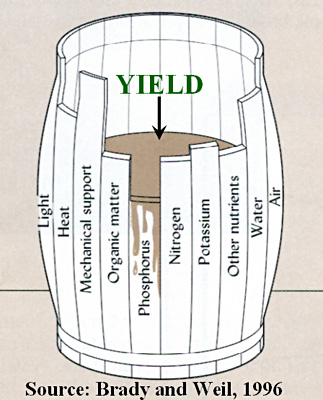


Being able to manage and control soil nutrient levels and ratios has been one of my primary motivating forces in order to provide my family with the best food possible.  Since food is foundational to good health, ultimately, the idea of providing excellent food and the resulting healthy outcomes is rooted in soil science.

Saturday, October 28, 2017

Acres USA - Soil Science

Acres USA, the monthly publication, led me down a path of discovery on how to optimize soil, leading to more nutrient dense food and healthier plants and livestock.  One of my idea, goals, or ideals has been to raise the best food possible for my family.  Acres USA led me down a path of figuring out how to do that, in part.


In the organic gardening and farming world, one of the key ideals, if not dogmas, is that healthy soils create healthy plants and healthy plants provide better nutrition to people and animals that consume them.  Anecdotal evidence suggests that this is generally true.  Washington State University has studied nutrient content of a variety of foods grown conventionally and organically, and finds with some level of regularity and consitency that organically grown foods have higher vitamin, mineral, and protein content than conventionally raised foods, but not always.  There are a lot of reasons why the generality is true and a lot of reasons why the specifics don't concur with the generalization.

From Acres USA and related publications, I have learned several things.  The soil is made from weathered rock and organic matter.  The rock is different from region to region, which leads to different nutrient profiles for soils in different areas.  Generally food and forage crops perform best with a good profile and ratios of various soil minerals, which originate with the native rock material.  Oganic matter in the soil promotes and sustains soil life (bacteria, fungi, and higher order life like earthworms).  The soil life, in conjunction with plant life work on decomposing the rock materials, making it available to other plants through a slow weathering and then infinitely recycling process of growth and decay.  If the native rock material in a specific region does not provide the optimal mineral profile, the food quality and quantity produced can be improved by supplementing with materials, preferably naturally occurring materials.  We generally think of that as fertilization.

I had heard about farmers farming a plot of land and then "farming it out," or depleting the nutrient levels of the land, then abandoning it and moving on.  This still happens today in the Amazon rain forests, where indigenous people slash and burn and area, farm it, then let it grow back to forest.  The interesting thing is that there is a cycle of farm, recovery (long recovery), farm, recovery.  The trees pull up minerals from the soil far below the soil surface, and deposit them on the surface through leaf fall, or the death of trees and surface decay.  The land naturally provides a mechanism to heal the soil.  Man's interference in otherwise natural processes should mimic that, perhaps at an accelerated rate.


As a basic example, one of the minerals that is considered a micro-nutrient is selenium.  It does a lot of good things for people and animals.  Here is the Willamette Valley, low selenium levels lead to white muscle disease in cattle.  The native rock material is low in selenium and the relatively high winter rain levels disolve and leach away much of the small amount that is there.  For optimum human and animal health, selenium needs to be supplemented.  Given that it is a micro nutrient, the levels required are minimal.  Selenium complexed in carbon as a food source is much more readily available than taking a mineral selenium supplment.  This is why I eat brazil nuts as a source of selenium.  The top six inches of an acre of soil is about two million pounds.  The amount of selenium per acre required is between one and two pounds.  That seems like such a trivial amount that one would wonder why it matters.  It does matter.  However, too much is toxic.  The holding capacity of the soil (CEC or TEC) and the total amount of a nutrient and the ratio of each nutrient to other nutrients all play important roles in the growth of healthy plants and animals, leading to optimally healthy foods for people.


The fact that since WWII, that farmers have been told to focus on three or four, maybe five soil nutrients is leading to a steady decline in the vitamin, mineral, and protein levels in the foods.  This is very well documented.  Farmers are told to focus on nitrogen, phosphorous, and potassium.  Separately, they accidentally focus to a degree on calcium through liming to correct soil pH.  Some farmers pay a little attention to sulfur, a precursor to the development of most proteins.  In effect farmers have not considered other nutrients because the focus on these things do create lots of pounds produced - but in decreasing nutrient density.

My goal is to grow food that is ever moving towards more optimal levels of nutrient density.  This is a key foundational element of my drive to have a farm.  The idea, ideal, and goal is to grow the best food possible for my family.  This can only be done if you pay attention to the soil and treat it appropriately.


Soil testing and understanding nutrient and mineral provides a foundation for understanding the first phase of soil treatment.  The soil needs to be optimally mineralized.  Once that is done, the foundation is set for increased soil biology and sustainable nutrient cycling, which when combined with plant selection and other food raising techniques, leads to the best possible food.  The starting point is soil mineralization. 

I have taken soil samples of our property and determined a few important things.  The soil is lacking in calcium in a fairly significant, but not unexpected way.  Magnesium is close, but a little short.  Potassium and phosphorous are both fairly abundant, perhaps to the point where I don't know that I will ever need to add these two elements, at least in the next several years.  Iron is high, sulfur is sufficient.  Zinc is low, selenium is low as well, as I suspected.  There are many other aspects to consideration, but these are foundational.  This is where I will start, along with the addition of a modest amount of compost.  The soil already has pretty good organic matter, but it could still be improved.  Making these soil corrections will set the foundation for the growth of fantastical foods.


While I did not learn all I know from Acres USA, the publication set me on the right path to understanding the soil and how to grow the best food possible within certain natural constraints and the very human constraint of imperfect knowledge.

Wednesday, September 13, 2017

Oats Harvested - What Next?

This past weekend, I drove by the property and saw that the oats had been harvested.  While I had not intended to walk the property that morning, I seized the opportunity.  As I walked the property, thoughts of "what next," flooded my mind.  One of the ideas that crossed my mind was getting a basic "soil correction" done for the property before the tenant farmer tilled the oat crop residue into the soil.


Earlier in the spring, I had taken a soil sample across the whole property.  The soil sample indicated that calcium levels were low, requiring about 300 pounds of actual calcium per acre, or about 800 pounds of high calcium lime (calcium carbonate).  Magnesium levels were in the right general range, so dolomitic lime would have been inappropriate.

Mid-summer I came across the Natural Resource Conservation Service (NRCS) soil survey maps of the property.  The maps suggested that the soils across the property were of different classes.  There were three basic categories of soils, Quatama loam, Verboort silty clay loam, and kind of a non-descript category of Xerochrepts and Haploxeralls.  The best soils on the higher parts of the land are Quatama loam.  The lower, drainage pathways were the Verboort silty clay laom. Lastly the area in the lower middle of the map that rolls off towards the stream bed below were the Xerochreps and Haploxeralls.  I think the last designation means that when they did the soil survey decades ago that the area was coverered by trees, so they didn't want to work to hard and climing through the undergrowth to properly categorize it.  But that's speculative on my part.


I had initially sampled the property in the spring as one homegenous property.  With this new soil map, I started thinking that maybe I should sample the three NRCS soil types independently to see if they were indeed dissimilar, meaning they should be treated differently, or if there was really no significant difference, meaning they could be treated the same.  I determined to sample the sections of the land that corresponded to the NRCS soil survey map.


I took my trusty soil probe to the property to collect 60 soil cores needed to do the sampling for three different soil types.  After about 15 minutes, I had taken about 1 1/2 cores.  The soil was dry and as a result, fairly impenetrable with a soil probe.  When I had taken samples back in April, taking the samples was a breeze because the soil was very moist.

Since I really could not get soil samples, I'm thinking that I'll wait on the soil correction until next year.  I don't know when the tenant farmer is going to till the oat crop residue into the soil, but it will probably be before the soil is in good condition to take soil samples.

In the meantime there are many other "what next" projects that are garnering my attention.

Sunday, August 13, 2017

Oats in the Morning

This was a photograph from a week ago at our property in the early morning, showing the oats that are currently planted and ripening.  I find it peaceful and idyllic.


Peaceful.  Engenders thoughts.  Direction.  Hope.

Acres USA - Finding the Outstanding Periodical at Barnes & Noble

Through the years, with my dabbling in trying to understand the path to sustainable food production techniques, I often found myself in various libraries, in obscure agricultural sections.  I read Mother Earth News and Countryside & Small Stock Journal.  I read writings from agricultural professors from the late 19th and early 20th century.  I read Rodale publications that ranged from Organic Gardening and Farming to books commissioned by Rodale.  Over and over again, I found approaches to agriculture and food production that I would call intuitive and experiential, if not empirical, but they also carried a taint of dogmatic certainty, if not a religious fervor.  When asking the question of "Why?", the answer would be something like, "Because! That is how it happens in nature."  More often than not the description of something that happens in nature failed to comprehend what actually happened in nature, but was simply a reiteration of something that some supposed guru of natural farming had said.  That said, the intuitive descriptions held truth and that truth drew me in.  The questions I had were about why something was true or maybe why did it look true, when in reality, it was a correlation, not a truth.  What's a wannabe natural farmer to do?

Another of my vices was taking an occassional break to wander through Barnes & Noble, usually to look at books on gardening, farming, livestock, maybe woodworking, or something else.  These visits were usually just a break from a busy day, with my leaving having relaxed and not spent a dime.

On one of my visits to Barnes and Noble in the mid-90's, I was walking through the periodical section, hoping to find something different than Mother Earth News.  Perhaps a revival of the defunked Rodale Organic Gardening?  Something else?  My eye was drawn to a farming periodical, Acres USA.  "How odd," I thought.  There are no other farming periodicals at Barnes & Noble, not even the popular Hoard's Dairyman.  I picked up the Acres USA and started thumbing through it.  My reaction was one of astonishment.  I saw things like: optimal nitrogen levels through legumes and carbon decomposion; balanced soils lead to higher protein and mineral content of vegetables and forage; milk from grass-fed cows has higher CLA content; laying hens following cows on pasture reduce fly populations by 83%.  You get the idea.


I snatched up a copy of the periodical, kind of like a mini-newspaper.  I took it home and read it and found that the content had not only the intuitive flavor of other publications that I liked, but also, sound science and research that my really answered the "Why?" questions that I had.  I subscribed to the publication immediately.  I have been more or less a constant subscriber for the past 20 years.  Not only does the periodical provide timely, new developments, it preserves lines of research that have been set aside as the vast majority of research funding in university agricultural programs currently comes from large agribusiness firms like Monsanto, Carghill, Tyson, Land O' Lakes, Purina, etc.  These older lines of research receive scant attention now because of funding and publication opportunities, but they remain just as valid today as they were 50 years ago.  While I do occassionally find things with which I disagree, the publication is not fanatical in its fervor about specific techniques or practices.  Not only does it outline sound science, but it explores topics and approaches that may be considered early research stage, unfunded research, speculative, even metaphysical.  But these things are made clear and are not communicated as a given truth, just because.


 As I became immersed in the periodical, I found that they had all kinds of books available, published by themselves as well as others.  The books generally spanned the range of topics available in the magazine, but in much more depth.  Over the years, I have purchased probably over 100 books from Acres, directly or indirectly.  Today I am reading a book by author Jerry Brunetti, called The Farm as Ecosystem.  As with the articles, the range of books, DVD's, and seminars available from Acres spans timely scientific, pragmatic, historical (yet current), and speculative.


Acres has become a primary source of information for me in my quest to understand and develop mental systems and models related to sustainable, renewable, regenerative agriculture that provides optimally nutrient dense foods in an efficient, reliable manner.

Just in case you can't tell, I like Acres USA.  If you have interest in this topic, you are sure to find things of interest at Acres, whether you subscribe to the periodical, or pick up a book to read.  I'll delve deeper into key specific issues learned from Acres in upcoming blog posts.

Monday, May 15, 2017

Stockman Grass Farmer Continued - Health Benefits

Ask yourself, "What was the diet of our ancestors in years gone by?"  Ask yourself, "How closely does what we eat today resemble what our ancestors ate?"  Depending on how far back in history you go, there is quickly a convergence to a few basic things: game, vegetables, seasonal fruits, eggs, and in some cultures whole grains and raw dairy products from animals not kept in confinement (today's conventional farming methodology).  Our ancestors thrived on those basic things.  The foods we eat today diverge sharply from the foods of our ancestors.  The Stockman Grass Farmer highlights some important ways in which the foods we eat today diverge from the diets of our ancestors and the health impact of the different foods we eat today vs. those that our ancestors ate.  The way in which our bodies operate and the nutrient requirements of our bodies have not changed appreciably over the last millenia or so, yet the food we consume to fuel our bodies has in fact changed markedly.


The Stockman Grass Farmer has highlighted work done by a variety of researchers and researcher authors regarding the impact to our foods related to managing animals on pasture vs. what is now considered conventional methods of animal rearing.  Interestingly, these "conventional" methods have only been conventional for the last 50-70 years.  Before them, those methods would have been considered unconventional or fadish, or perhaps, "new-fangled," depending on with whom you spoke.

Let's consider a few representative animal products.  First, let's talk about chickens.  Historically, chickens were fundamental to a diversified farm.  The chickens free-ranged.  They ate bugs, grass, worms, weed seeds, occassional rodents or small snakes, rotten fruit, kitchen scraps, and the occassional handful of grain tossed out by the farming family.  Chickens largely fed themselves.  They worked on the farm by minimizing pest pressure and cleaning up things that would have otherwise gone to waste.  I chuckle everytime I see a carton of eggs at the store that says, "100% Vegetarian Feed."  Seriously?  Anyone who has had chickens knows that chickens are not vegetarians.  How in the world it could be considered a good thing to feed an omnivore a vegetarian diet is beyond me.  The chickens got out, exercised, had a broadly varied and nutritional diet.  What about the animal products that humans eat that resulted from that chicken diet?  Eggs and meat are the primary products.

Have you ever seen a fresh, free-range chicken egg compared to a store bought egg?


Store bought on the left, free-range on the right

Eggs from chickens with access to fresh grass are dramatically different from eggs from caged layers fed a mixture of soy, corn, and a few minerals on a feed conveyor belt in a totally enclosed, climate controlled factory egg farm.  A few years ago The Mother Earth News commissioned a study that compared eggs from free-range hens to conventionally raised and confined hens.  Let's just say that the eggs have some stark differences, including vastly higher beta carotene, vitamin D, omega 3 fats, retinol, etc.  Additionally, the taste is much richer.  Baked goods baked with free-range eggs are better formed - from many bakers in the kitchen at my house.

Currently, in the U. S. the per capital consumption of chicken is about 90 pounds.  That is a ratio that is unprecedented.  Historically, excess roosters were eaten as "fryers" or broilers and old hens, past productive laying years, were eaten as chicken stew or chicken soup.  Per capita consumption of chicken was 5-10 pounds 100 years ago.  That is no longer the case.  Historically, all of those good things that were in the free-range eggs were found in the meat of the free range chickens, which similarly, is a far cry from the factory raised meat chickens of today.  Today's conventional meat chickens eat a diet that is largely based on corn and soybeans.  But meat chickens can successfully be raised on grass and gain the same nutritional benefits of the free-range chickens of yore.  These pasture raised chickens have access to grass, bugs, worms, sunlight, fresh air, etc., that help to build a more healthy nutrient profile in their meat.


What about grass-fed beef?  Animals raised soley on mother's milk as young calves and grass for the remainder of life have a vastly different nutrient profile to their meat that animal raised on the range for 2/3 of their lives then corralled in a confined animal feeding operation (CAFO) for the last 1/3 and feed an unnatural diet of corn, a little hay, corn silage, more corn, bakery waste, more corn, brewer's spent grain, sodium bicarbonate (to offset the extreme acid stomach conditions caused by the corn), hormone implants, rendered fat, and a few minerals.  To be clear, the diet that beef animals receive in a CAFO would be analogous to a human being fed a daily diet of four dozen doughnuts, a small ham sandwich, a serving of broccoli, and going on female hormone replacement therapy, whether male or female, intact or not.  Large game animals, such as deer and elk have an omega 6/3 ration of somewhere between 1/1 and 2/1.  Grass fed beef has a similar omega 6/3 ratio.  CAFO fed beef has an omega 6/3 ratio of about 20/1.  Is that bad?  An imbalanced ratio will lead to inflammation in the human body leading to heart disease, dementia, arthritis, some cancers, diabetes, and a host of other ailments.  Grass fed beef (and dairy products) also is high in conjugated linoleic acid (CLA) which prevents cancer and can stall or even reverse it in some cases.  Grass-fed beef is high in beta carotene, retinol, vitamin D and other nutrients contained in low levels for conventionally raised beef.


Other pasture raised animal products that provide humans benefits are wide and varied.  Omivores that pass along similar benefits as chickens include turkey, duck, guinea hen, and pigs.  Ruminants benefit the most from being pasture raised.  In addition to beef cattle, sheep, goats used for meat pass along the same benefits.  Additionally ruminants kept for dairy products pass along the same benefits in their dairy products.  Although there may have been other confounding factors in the study, Dr. Weston Price documented the clear seasonal decline in heart related deaths that corresponded to the spring time fresh supply of grass-fed butter in the U. S. back in the 1930's.

Grass-fed butter on left, conventional confinement butter on right

While books could be written on the health benefits of pasture and grass to both animals and humans consuming animal products (and they have), a clear, concise, well-written summary of benefits may be found in an article written by Jo Robinson, Health Benefits of Grass-Fed Products.

I would also say that as a side benefit, just seeing animals out on pasture provides health benefits.  Pastured animals provide and idyllic scenery that causes peace and contentment....  I may only be speaking for myself.  I will let you be the judge of that....


Saturday, May 13, 2017

BREAKING NEWS! - I Interupt This Irregularly Scheduled Blog

It is with some excitement, trepidation, relief, joy, and a few other miscellaneous emotions that I interupt this irregularly scheduled blog to announce that "the farm" deal has been closed.  Michelle and I are now the official owners of 5.4 acres, just north of Cornelius, Oregon.

The property is on the left half of the photo, gently rolling off to the south.

The property is relatively long and narrow, about 900 feet by 270 feet.  The long axis is east to west.  The short axis is north to south.  The southern edge borders Council Creek, a small creek with wetland characteristics on the edge.  The creek area is treed, as is the southern border of the property.  The property is located in what is called a "Rural Reserve" from the Metro area planning committees.  It was designated rural reserve in 2015.  Once an area is designated Rural Reserve, it cannot be changed for 50 years.  That means that no one can build subdivisions or subdivide their properties and build new houses.  In other words we cannot be directly subjected to encroaching suburbia in that time frame.  A tiny portion of the southern edge falls within the 100 year flood zone, although the big floods of 1996 did not encroach on the property at all.

The property is currently being farmed by a long-time share-cropping tenant farmer.  He farms other adjoining properties in the immediate area.  He will continue this year as we work on house and farm designs.

We don't know exactly where the house will be located.  The exact location will be dependent on a few things, including a long visit down at the county planning office to determine exactly what our options are.  That said, the photos shown below represent an approximate location of a house and the directional views from that spot.

Looking directly south from possible house location

The house siting is a primary consideration, but we need to take into account driveway location, septic field location, shop location, and small barn location as part of the decision process.

Along the southern edge, which is treed, I had thought about placing a sitting bench or two and maybe a picnic table or two for eating lunch, chatting, and observing nature in what would effectively be a private park.


Looking southwest from possible house location

The house design process will give us some time to observe the property and to apply what is often considered a basic Permaculture principle of "observe and interact."  This will provide a chance to observe the property and what happens through the different seasons.  Such observations can and will impact how we determine we will use the whole of the property.  There are questions about where the barn will go and where the kitchen garden and the production gardens will go.  How about the small fruit orchard?  Where will that go?  Root cellar?  Permanent pasture?  Rotating production areas?  Greenhouse?  Water catchment?  Chicken coop?  Compost piles?  Woodshed?

Looking west from possible house location

Where does the fire pit go in the backyard?  How about play equipment for grandchildren and visitors?  How about play equipment for me?

Looking northwest from possible house location

If you look at the property descriptions, it says the views are "territorial."  I take that to mean that they are pleasant countryside views, but not views of grandeur as you may get from a mountain top property.  In walking the property with Hunter, several times he said, "Stop, listen!"  What did we hear?  Rustling trees, birds and the sweet sounds of nothingness: no cars, no horns honking, no sirens.

Looking directly north from possible house location

Some of the views may require some strategic landscaping, but that is all part of the fun.  

I have met the neighbor to the north and to the east.  To the north is an independent entrepeneurial machinist, a very nice guy.  Across the street to the east is a retired "car buff" couple, who keep an immaculate yard.  There is a neighbor to the southeast, but I have yet to meet the family.  There are no neighbors directly to the west, although there is the possibility of one house being build on that property at some point in the future.

Looking northeast from possible house location

The neighbor to the north has a garden and a few fruit trees.  I will have to figure out how to establish fruit trees and berry bushes without the neighboring black tail deer population stopping by for a meal of fresh leaves, twigs, and stems.

Looking east, towards the road, from possible house location

The rolling nature of the property provides a lot of interesting options as well as some challenges.  It will be part of the fun of the property, but I expect there will be frustrations as well.

Looking southeast from possible house location

There is lots to learn and lots to do.  I look forward to it with the hopes and dreams built through life.  A couple of ideas expressed by Thoreau seem relevant at this time.  He said, "Go confidently in the direction of your dreams.  Live the life you have imagined."   I also take some caution from another quote from Thoreau, "The youth gets together his materials to build a bridge to the moon, or, perchance, a palace or temple on the earth, and at length the middle-aged man concludes to built a wood-shed with them."  I am hoping age, learning, and perspective may have moved me away from ideas of grandeur such as building a bridge to the moon.  However, I hope that same set of experiences has not made me so cynical that the only thing I could imagine is building a wood-shed.  But the idea of a well-designed and well-built wood-shed is really quite exciting..., my age is showing.

Next blog will return to the regularly scheduled program, including further analysis of the Stockman Grass Farmer.